Repaired where a repair is honest and replaced where it is not, with the pipework between the tank and the taps checked before anybody sells you a new tank.
Online Now!·--:--
The most frustrating hot water call we take is the one where somebody has already spent the money. New unit, professionally installed, and the exact same complaint the following week.
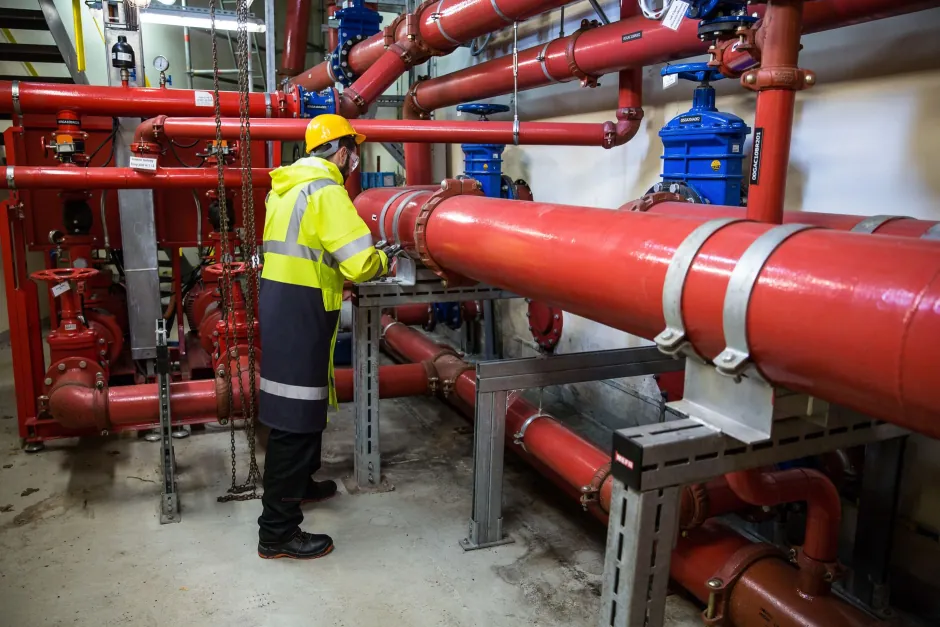
The explanation is nearly always the same. In housing of this age the appliance and the pipework are two separate things with two separate histories. A changeover replaces the appliance. The distribution pipework running from it to every tap in the house stays exactly where it was, and in an older property it is frequently original.
So it matters enormously what the complaint actually was. If the unit was not producing hot water, replacing it was the right call. If the complaint was about what arrives at the tap, discoloured, slow, or weaker than the cold beside it, then the problem was between the tank and the tap and a new tank was never going to touch it.
The check is not complicated. If the cold at a given tap behaves normally and the hot does not, the difference is on the hot side. That is worth establishing before an order goes in rather than after a unit is installed and the household is disappointed.


Then the unit was not the fault. Get the pipework between the tank and that tap looked at before anybody suggests another unit.
A changeover replaces one of them and leaves the other exactly where it was.
In older housing the distribution is frequently original.
If the cold is normal and the hot is not, the difference is on the hot side.
It is the simplest useful test there is and it costs nothing.
Points at the pipework rather than at the cylinder that has just been removed.
Which is exactly the conversation nobody had before the order.
Nothing silts up here. The anode corrodes deliberately so the cylinder does not.
Renew it and you buy years for a fraction of a replacement.
The steel has gone and there is no patch for that.
Shut it off and arrange the swap before the floor joins the bill.
If the diagnosis really is the unit, then the choice is between five types. Here is what separates them in practice rather than in a brochure.
| Type | How it works | Expected span | What it needs |
|---|---|---|---|
| Electric storage | A submerged element warms a stored volume | About 8 to 12 years | A position and a circuit, and very little else |
| Gas storage | A burner beneath keeps the volume hot | About 8 to 12 years | Gas connected and flue clearances met |
| Continuous flow | Heated in transit, nothing stored | About 15 to 20 years | Gas, and a compliant wall position |
| Heat pump | Ambient warmth moved into the tank | About 10 to 15 years | Outdoor space with genuine airflow |
| Solar with boost | Roof collectors with an element for poor weather | About 15 to 20 years | Roof area with a workable orientation |
A starting point rather than a rule. Storage is judged on how much can be drawn before it empties, so the number that counts is how many people want hot water inside one hour.
| Occupants | Electric storage | Gas storage | Continuous flow |
|---|---|---|---|
| One or two | 125 to 160 L | 90 to 135 L | 16 L/min |
| Three to four | 250 to 315 L | 135 to 170 L | 20 L/min |
| Five or more | 315 to 400 L | 170 L or twin | 26 L/min |
| Two bathrooms at once | Size up a step | Size up a step | 26 L/min |
Fixed price agreed before anything starts. These are indicative 2026 ranges.
Including whether the fault is the unit or the pipework, and it comes off the work.
The most common electric fault, and the reason a cold tank is not automatically a dead one.
Cheap insurance on a cylinder with years left in it.
Unit, install and removal of the old one, in one figure.
On the run, and only where that is genuinely where the fault is.
Electric storage through a good deal of the older housing here, gas where a property is connected for it, and continuous flow wherever a cylinder had to come off the floor. These are the makes involved.
We service and replace these systems as an independent licensed plumber. We are not an agent for, or endorsed by, any of these manufacturers.


No hot water at all is one problem. Something wrong with the hot water that does arrive is a different one entirely.

Including comparing the hot to the cold at the same outlet, which frequently ends the diagnosis on the spot.

Anode, element or thermostat where that solves it, and a changeover only where the unit is genuinely the fault.

Which on this suburb is the point of the exercise: the water at the outlet, not the appliance in the yard.
A licensed plumber answers directly. Repairs are usually same-day and plenty of changeovers are too.
Call 1300 381 569
Because in older housing the unit and the pipework are two different ages. A changeover replaces the appliance. It does not replace the distribution pipework running from it to the taps, and in a house of this vintage that pipework is frequently original. If the complaint was about what arrives at the tap, replacing the thing that heats the water was never going to change it.
Discoloured hot water that persists after a new unit goes in. Hot water that takes a long time to arrive at one particular outlet. Flow at one hot tap that is noticeably worse than the cold beside it. All of those are about what happens between the tank and the tap.
By checking the pipework rather than only the appliance. If the cold at the same tap behaves normally and the hot does not, the difference is on the hot side and the unit is not automatically the suspect. It is a straightforward thing to establish and it is worth establishing before an order goes in.
Soft water is why they fail this particular way. In hard-water places a tank silts up with scale. Sydney's is not like that, so the sacrificial anode is consumed protecting the steel and the tank starts corroding once it is gone, or an element burns out. Both are frequently repairs.
On a unit you plan to keep, it is the best value job in this trade. It costs a fraction of the tank it protects and it is the only maintenance that genuinely adds years.
Replace. Water from the body of the cylinder means the steel has gone and there is no patch for that. Shut it off and ring, because the damage compounds daily.
Diagnosis is $120 to $250 and comes off the repair. An element or thermostat is $250 to $550. An anode is $300 to $600. A storage replacement is $1,400 to $2,800. Replacing a run of hot water distribution pipework is quoted on the run.
Tell us whether there is no hot water at all, or whether there is something wrong with the hot water you are getting. Those are two different jobs and only one of them is the tank.
Diagnosed properly first, so nobody buys a unit that was never the problem.
Online Now!·--:--